
Water Storage with the Weeping Jug
Weeping Clay Water Storage Benefits
- Naturally Cooling: Because clay is porous, clay pitchers naturally cool water through evaporation
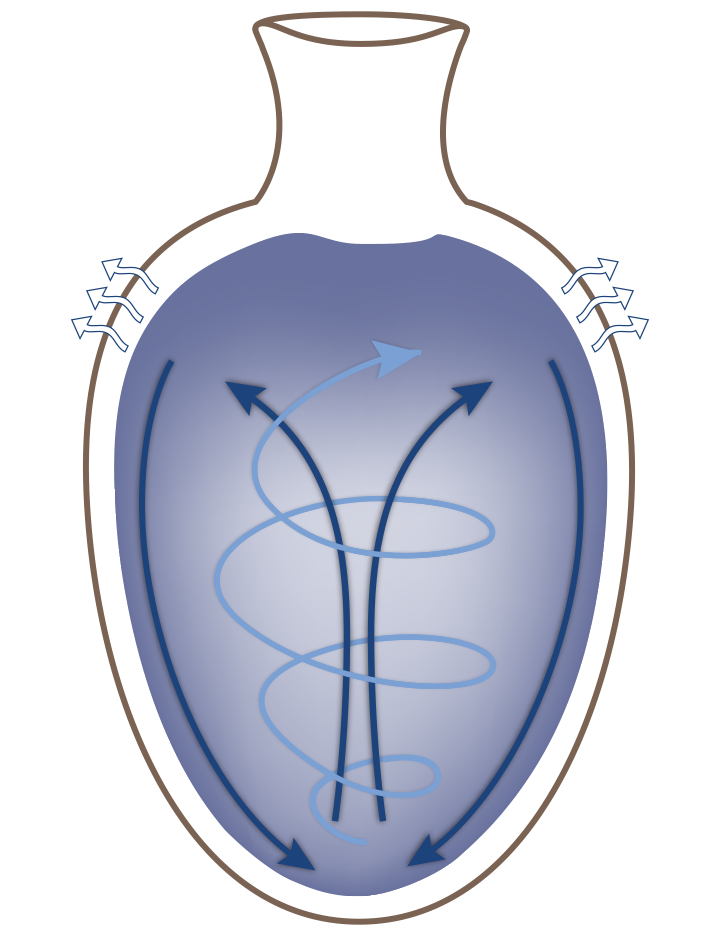
- Constant Flow: The evaporation-induced temperature differences causes constant movement within the vessel:
- Evaporation cools the outer walls and adjacent water
- Cooler denser water sinks to the bottom
- This displaces water at the bottom, forcing it to rise up the center and move towards the outside
- Prevents Bacterial Growth: The absence of corners and crevices in an ovaloid/egg shape prevents stagnation zones where parthenogenic bacteria are able to propagate.
Clay Health and Wellness Benefits
- pH Balance: Clay is alkaline in nature, which helps balance the waters pH and can provide relief from gastrointestinal issues.
- Hormone and Metabolism Maintenance: Unlike plastic containers, clay pitchers may help maintain testosterone levels in the body which are vital for a healthy metabolism
- Mineral Infusion: Clay pitchers are rich in minerals, assisting in optimum hydration
- Filters Impurities: Clay pitchers imbue continual motion of liquid, which helps adsorb impurities to the clay *4
- Electromagnetic: While this is more commonly associated with specific types of ceramics, some suggest that clay’s mineral content imbues electromagnetic energy, potentially charging water with additional “healing powers”
Environmental Advantages
Eco-Friendly/Biodegradable/Sustainable: When ceramics have reached the end of their usefulness as water vessels, they can be used as planters, garden decoration, or return to the dirt from which they were made, creating more soil instead of more waste.
Clay Disadvantages
- Fragility
- Temperature sensitivity: Avoid sudden temperature changes (e.g., do not put a hot clay jug in cold water) to prevent cracking
- Maintenance:
- Before first use, clean the jug by scrubbing gently with water and a non-abrasive scrubber such as coconut fiber or soft plastic scrubber. Avoid using soap or detergents as the porous clay can absorb chemicals which may later contaminate the water.
- Season the new jug by soaking it in starchy water such as rice-wash water or lentil water for 2-3 days, changing the water daily. This removes the raw clay smell and strengthens the pot.
- After soaking, rinse thoroughly with clean water until no muddy residue remains. Let the jug dry completely before use
- Store the jug in a cool, dry, and ventilated place to prevent mold growth. If mold or fungus develops due to damp storage, scrub well and soak the jug in a mixture of vinegar and baking soda, then boil water in it and dry thoroughly before reuse
- Place a plate or stand under the jug to catch any seepage and prevent water damage to surfaces
- Clean the jug regularly by rinsing with warm water and scrubbing gently. Baking soda or lukewarm water can be used for cleaning to keep pores open and remove deposits
The Opposition
Plastic (i.e. Nalgene, etc)
– Environmental Impact: While designed for long-term use, these bottles still contribute to plastic waste when they eventually need replacement
– Chemical leaching (BPA, BPA Alternatives)
– Microplastic Shedding: Even newer Tritan-based Nalgene bottles shed microplastics into the water they contain
– Degradation over time and exposure to sun, leading to an unpredictable lifespan
Stainless Steel
– Manufacturing impact: The production of stainless steel can be energy-intensive and likely has environmental impacts related to mining and processing raw materials
– Maintenance: Stainless steel bottles require proper cleaning to prevent bacterial growth and maintain water quality
– Contaminant leaching: Some experts suggest possible nickel and chromium leaching from stainless steel. However, different grades of stainless steel have varying levels of resistance to corrosion, and high-quality stainless steel typically poses minimal risk of significant nickel or chromium release. Stainless steel generally does not leach into plain water at normal temperatures. However, when exposed to high heat, like boiling water, some leaching may occur. Acidic or alkaline liquids are more likely to cause leaching compared to neutral pH water. While boiling water itself is neutral, adding tea or other substances could increase the likelihood of leaching
– Corrosion potential: Typical city tap water that contains chlorine, fluoride, and other common chemicals can potentially cause corrosion in stainless steel vessels, especially if the water is left stagnant for long periods.
– Metallic taste: Sometimes, water stored in stainless steel bottles can have a slight metallic taste
*I WANT TO USE STAINLESS STEEL ANYWAY*
- choose only highest quality, reducing risk of significant chemical leaching.
- Properly maintain them; like other non-porous water bottles, stainless steel bottles require regular cleaning to prevent the buildup of microorganisms.
- Avoid prolonged exposure to boiling temperatures to prevent leaching
- Be aware of your local water chemistry to prevent corrosion and leaching
Glass
– Light Exposure: excessive sunlight exposure in clear glass vessels may inhibit waters hydrating properties by agitating the oxygen molecules causing increased oxidation, and promoting algae growth in stored water by increasing temperature. Using darker glass can mitigate this issue but may limit options
– Etheric Exposure: colored glass vessels imbue the contained water with etheric energies according to the wavelengths of light allowed to pass through, and therefore may be used to balance or unbalance energies in ones etheric body
– Potential Chemical Leaching from Lid Materials: While glass itself does not leach chemicals into water, the materials used in bottle caps (often made from plastic) can sometimes leach substances like BPA into the water, particularly if exposed to heat
– Maintenance: like other non-porous water bottles, glass bottles require regular cleaning to prevent the buildup of microorganisms.
– Fragility
Copper
– Studies have shown that copper is more effective than earthen and stainless steel vessels in killing the bacteria during water storage, however it also poses risks related to copper toxicity and should be approached with caution to avoid negative health effects
– Limit Contact Time: To minimize copper leaching, avoid leaving water in contact with copper surfaces for extended periods before boiling. The Ayurveda describes storing water in a copper vessel overnight and drinking it in the mornings for many health benefit
– Use Cold Water: hot water tends to leach more copper from pipes and vessels
BIBLIOGRAPHY
1. The Ovoid Shape:
https://www.dancingwithwater.com/using-an-egg-shaped-water-vessel/
2. “Living Water: Viktor Schauberger and the Secrets of Natural Energy” by Olof Alexandersson https://library.uniteddiversity.coop/Water_and_Sanitation/Living_Water-Viktor_Schauberger.pdf
3. Water PH:
https://www.healthshots.com/healthy-eating/nutrition/6-health-benefits-of-drinking-water-from-an-earthen-pot/
4. Clay Vessel Benefits:
https://www.terrawaterindonesia.com/post/drinking-water-from-a-clay-pot-is-it-healthy-or-outdated
5. Clay Vessel Benefits:
https://happytummy.aashirvaad.com/en/fitness-wellbeing/earthen-pot-benefits/
6. Clay Pots are Sustainable :
https://pmc.ncbi.nlm.nih.gov/articles/PMC11247066/
7. Quality Assessment of Water Stored in Vessels Made of Different Materials:
https://journals.lww.com/joay/fulltext/2021/15040/quality_assessment_of_water_stored_in_vessels_made.9.aspx
8. Tritan Plastics:
https://www.noplasticnoproblem.com/blog/tritan-nalgene-bottles-leach-microplastics-especially-in-the-dishwasher
9. Effects of Microplastics:
https://www.noplasticnoproblem.com/blog/what-are-microplastics-and-their-health-effects-on-humans
10. Effects of Sunlight on Water:
https://www.sciencedirect.com/science/article/abs/pii/S0278691523001308
11. Copper in drinking water: https://www.health.state.mn.us/communities/environment/water/contaminants/copper.html